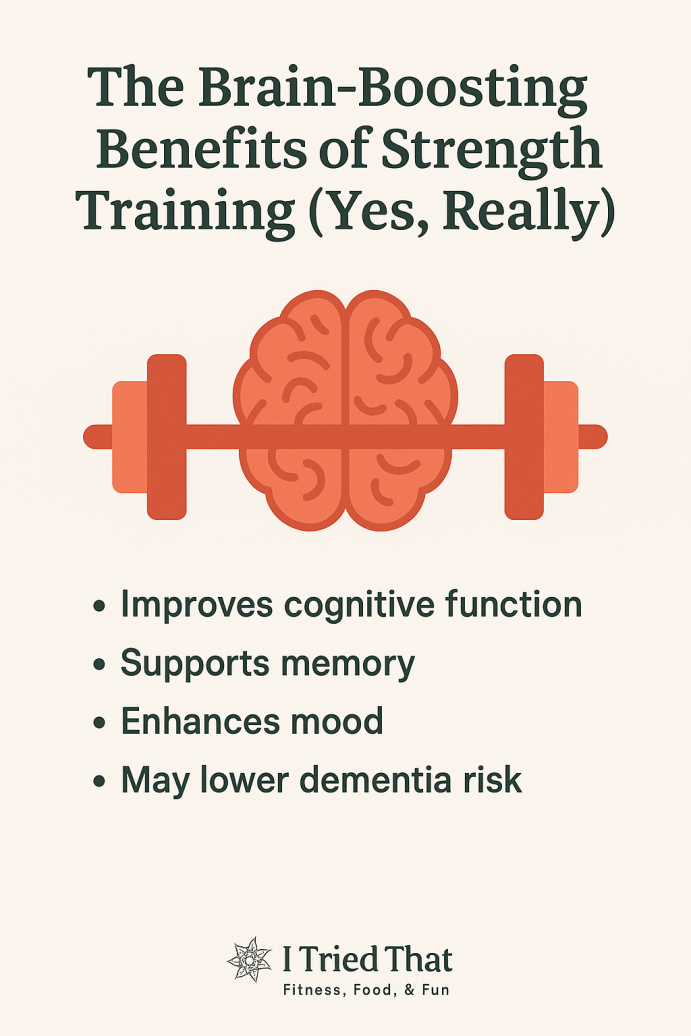
If you asked me a year ago whether lifting weights could help memory or focus, I’d have raised an eyebrow. But after diving into the research—and doing a small personal experiment—I now regard strength training as not just body fuel, but brain fuel. Here’s what I found (and what I tried), plus how you can make strength your secret weapon for mental sharpness well into midlife and beyond.
Why we need brain protection after 40
By the time you hit your 40s, hormonal shifts, inflammation, and less physical stress on the brain contribute to subtle declines in memory, processing speed, and executive function (decision-making, multitasking). Many women begin to notice “brain fog” or slower recall. But research is increasingly clear: physical exercise isn’t just good for muscles and heart—it’s among the best tools we have to guard cognition.
What science says: strength training and the brain
- A 12-week study in older adults found that resistance training led to about a 19% boost in cognitive capacity (measured via standardized tests), along with large strength gains. PMC
- Long-term research shows that regular resistance training can preserve white matter volume in the brain and protect against cortical atrophy in older women. PubMed
- Meta-analyses have concluded that strength training produces functional brain changes, improving executive function, processing speed, and memory, often more so than aerobic training alone. Frontiers
- In one trial of adults with mild cognitive impairment, participants who did weight training twice a week for six months performed better on memory and thinking tests, and retained those gains a year later. Harvard Health
- Strength training also appears to reduce systemic inflammation (a known risk factor for cognitive decline), alter levels of IGF-1 (a growth factor supportive of neurons), and moderate other metabolic processes linked to brain health. PMC
- Newer studies suggest that combining resistance training with cognitive challenge (dual-tasking) or moderate aerobic work can amplify brain benefits. Nature
So yes—lifting weights can directly support your brain, not just your biceps.
What I Tried: My 6-Week “Brain Gains” Trial
To see this scientifically-backed promise in action, I committed to a 6-week strength-focused block. My routine included:
- Two full-body strength sessions per week (squat, press, row, hinge)
- Progressive overload (adding 2–5% when form was clean)
- A cognitive twist: in one session I added a “dual-task” element (press + verbal recall)
- Tracking both my strength and focus (reading speed, memory tasks, brain fog)
By week 4–5, I noticed subtle shifts: I was less easily distracted, I remembered small details more readily (like names, where I set my keys), and mental fatigue in the late afternoon felt milder. My strength improved too, but the surprise was that my mind seemed sharper.
It wasn’t dramatic, but it felt real. Because memory and focus aren’t flashy muscles, changes are gradual, but they accumulate.
How to use strength training as brain insurance (for 40+ women)
- Start with 2 strength sessions/week
Use multi-joint lifts (squats, deadlifts, presses, pulls). Even moderate weights can activate brain pathways. - Progress slowly and consistently
Gains in strength often track with brain gains. In studies, the largest cognitive improvements were in those who progressed most in strength. Harvard Health - Include cognitive challenge
Occasionally embed dual tasks (e.g. recite a list or do a mental puzzle during rest, or combine balance + strength). Some trials show these blends outperform strength or aerobics alone. Nature - Manage inflammation & recovery
Sleep, nutrition, and stress management support the brain benefits of strength (inflammation can undermine gains). Strength training itself helps reduce inflammatory markers. PMC - Mix with aerobic or movement variety
While strength provides unique brain benefits, combining it with walking or interval work gives you “both sides of the coin.” ScienceDirect - Be patient & track subtle wins
Unlike a 5 lb difference on a scale, brain gains emerge in sharper thinking, easier multitasking, less mental fatigue. Keep a journal, test memory, or do puzzles to notice changes.
Why this matters (especially for women 40+)
Cognitive decline is nobody’s destiny. For women, hormonal transitions and midlife demands often make memory slips more stressful and more visible—“mom brain,” brain fog during perimenopause, juggling family and work. Strength training gives you a proactive tool to slow, and sometimes reverse, mental aging.
Because strength isn’t just about resisting gravity, it’s about resisting forgetfulness.
If you’re ready to future-proof not just your body but your mind, start a strength habit your brain can love.💪
Download a free strength-training guide 👇
👉 Download my free dumbbell guide 👈
👉 Download my free kettlebell guide 👈

Leave a Reply